When times are scary, head to the garden

Tasty little red apples

Tasty little red apples

These have been a tough few weeks.  I caught a bad cold a few weeks ago and am still recovering.  I had to fly to NYC on a business trip and I am not exactly a good flier.  And of course, the big one, the financial world as we know it is melting down.  We’ve gone from bad to worse to worse yet and there is no end in sight.  There are no easy answers.  Sell stock or don’t.  Panic or hold tight.  I have no idea.  So I am focusing on the things I can control.  The things most immediately around me. This sure is a good time to have a garden.  Gardening allows me to do something constructive.  There is a clear purpose and I have a clear role in that purpose.  I can go out to a tree, pick an apple and eat it. We have some really nice little red apples.  And I’d sure rather think about those apples than think about all those things I can’t control.  Here’s what we can control, and some of things we’ve been doing.  
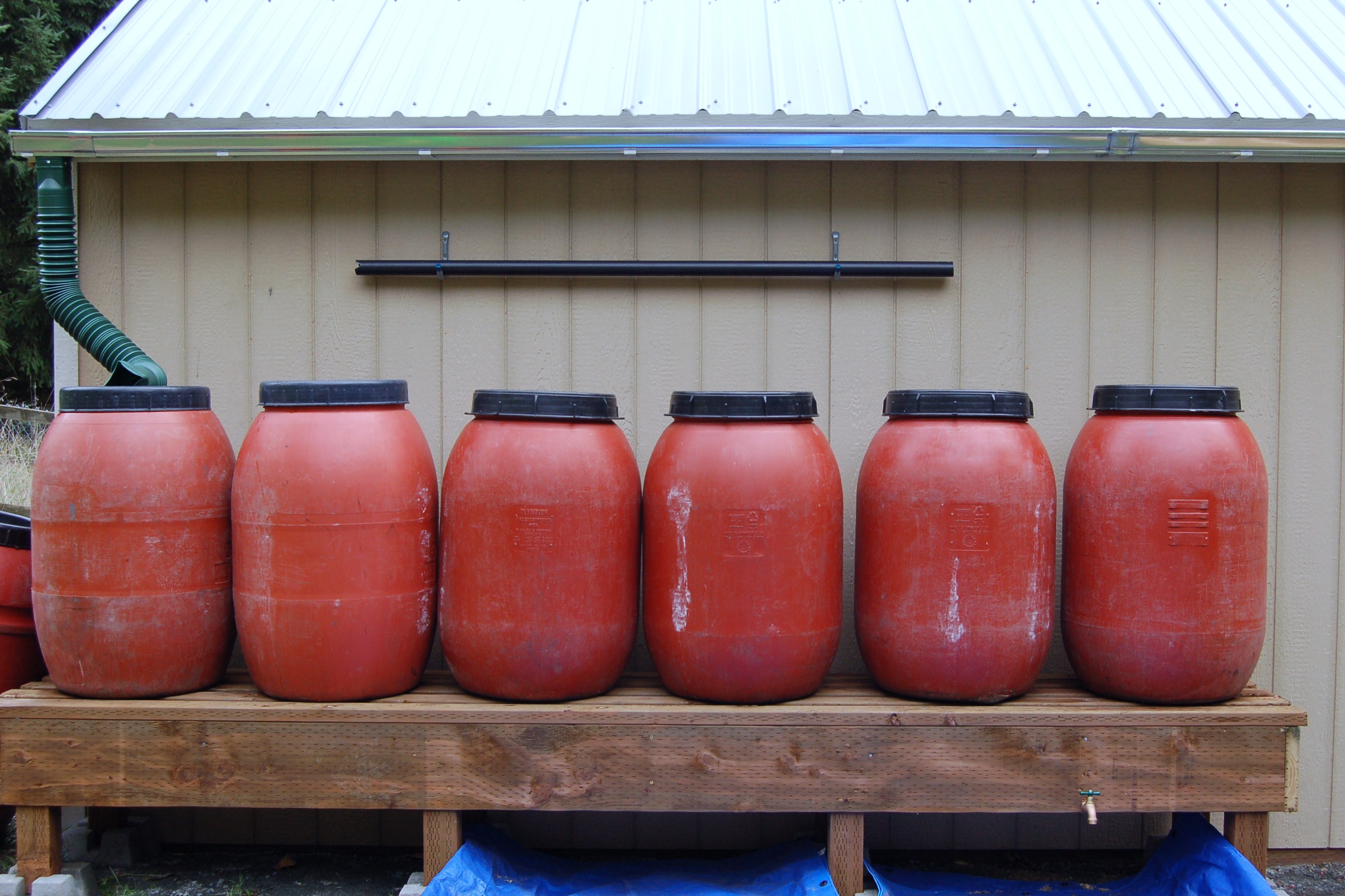
Rain barrel platform

Rain barrel platform

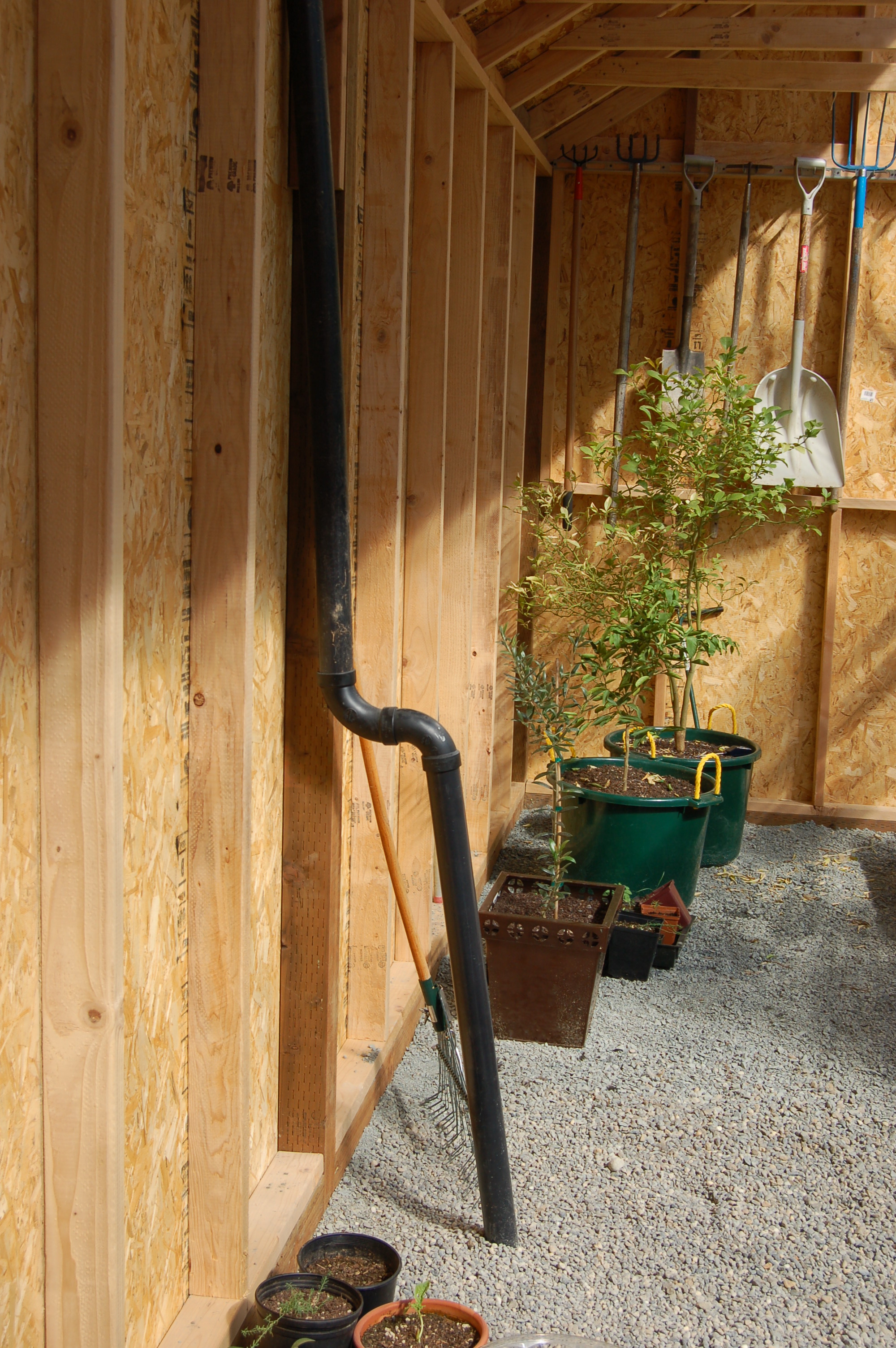
Water barrels.  Huge kudos to Derek and my brother-in-law Jeff for setting up the elevated rain barrel system.  Water runoff from the greenhouse will fill the barrels and then gravity will do its magic when we need water.  In addition to the spigot on the bottom of the platform, Derek is also planning to put a spigot inside the greenhouse, by piping it through the wall.  We have four other barrels that we are going to set up a bit closer to the house.
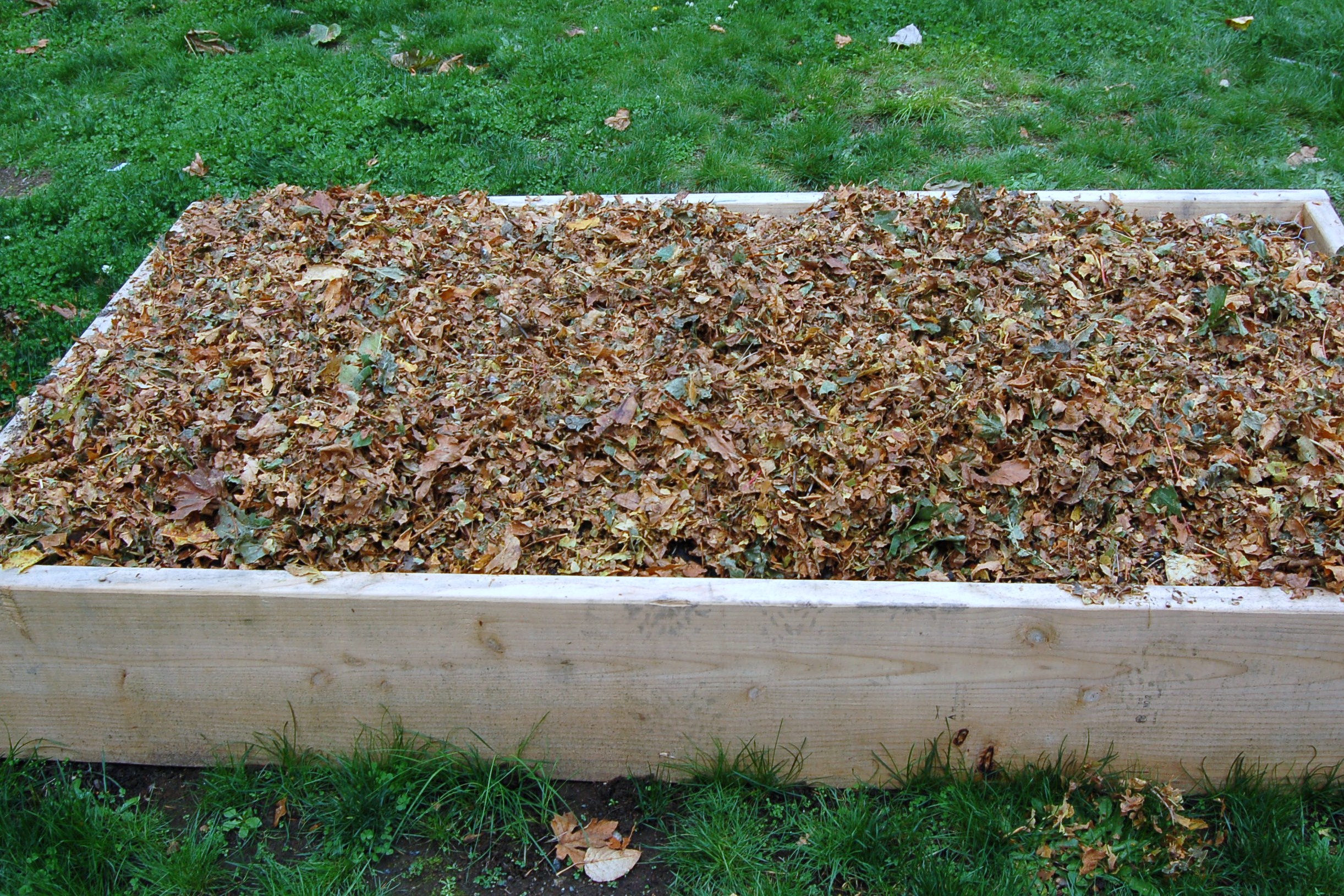


Leaf mulch in raised beds

Leaf mulch in raised beds

Mulching leaves.  We have a giant big leaf maple tree in our yard.  This tree must have hundreds of thousands of leaves on it.  It has dropped maybe 25% of its leave so far and they are everywhere already.  Today, I spent some time running some of these leaves through an electric leaf mulcher.  I am planning to use it as a mulch, covering the outdoor raised beds.  I also plan to use leave mulch for a lasagna garden planting area I am also going to set up.  The good news is that I will have lots of leaf material to use.  The bad news is that this is a whole lot of work.  Seems like the perfect job for my nephew Ryan, if I could get him to come out for a visit.  
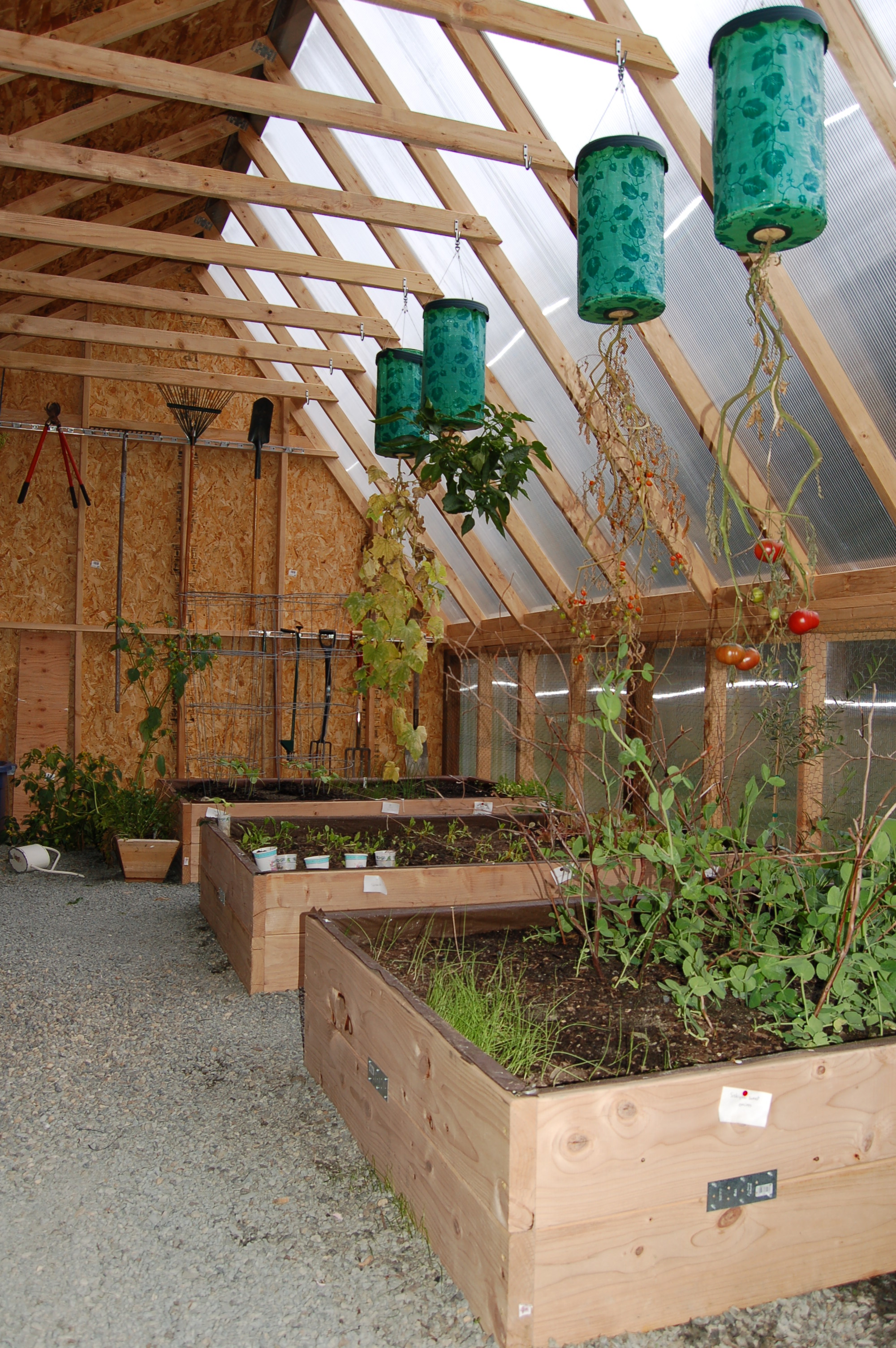
Fall growing in the greenhouse

Fall growing in the greenhouse

Tending to the fall crops.  I’ve planted a number of things for fall harvest:  carrots, lettuce, radish, pea pods, cabbage, broccoli. I’ve noticed some problems with what I think are cabbage moths and will be whipping up a recipe from the Terrific Garden Tonicsbook to see if it will help.  From the greenhouse, I am also still harvesting tomatoes and peppers and have modest hopes of getting the greenhouse-friendly cuke to grow. 

I’ve also ordered a number of books recently for fall/winter reading.  On this list:

As much as I try to keep my mind focused on other things, in the back of my mind I am thinking about emergency plans.  Could I rally the neighbors, if needed, to create a neighborhood food production plan?  We all have big yards and with a coordinated effort we could probably do a lot.  Should we start stocking up on dry good staples? Probably smart from an inflation hedge perspective anyway.  Is thinking this way prudent or paranoid? I have no idea, but the little knot that has been forming in my stomach over the last week feels persistent, nagging, urging me to do something. For now, that something is gardening.  It’s a good time to have a garden.

Sandy

Posted in Gardening | Tagged , , , , | 4 Comments

Here comes the rain: Barrels, clotheslines, firing up the furnace, and chocolate zucchini bread

Rain barrels, sort of hooked up

Rain barrels, sort of hooked up

Summer in Seattle is short and can end abruptly.  In the last week, we’ve gone from days in the 80s to barely hitting 60, with lots of rain to boot. The change in weather has impact on many aspects of our greener living plans.

First, the positive.  It sure is easy for us to collect and store rain water. As you can see in the photo, we’re diverting the rain water off our greenhouse roof into our rain barrel.  With just one day of rain, the first barrel is pretty full. We’ve ordered an additional six rain barrels, which will bring the total to 10.  It won’t be hard to fill them all up.  As you can also see in the photo, the barrels are not yet connected.  This is one of the many items on our fall to do list.

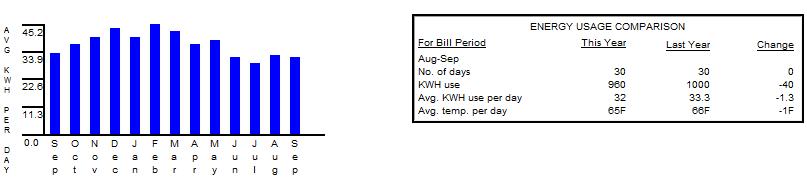
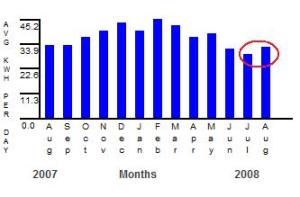
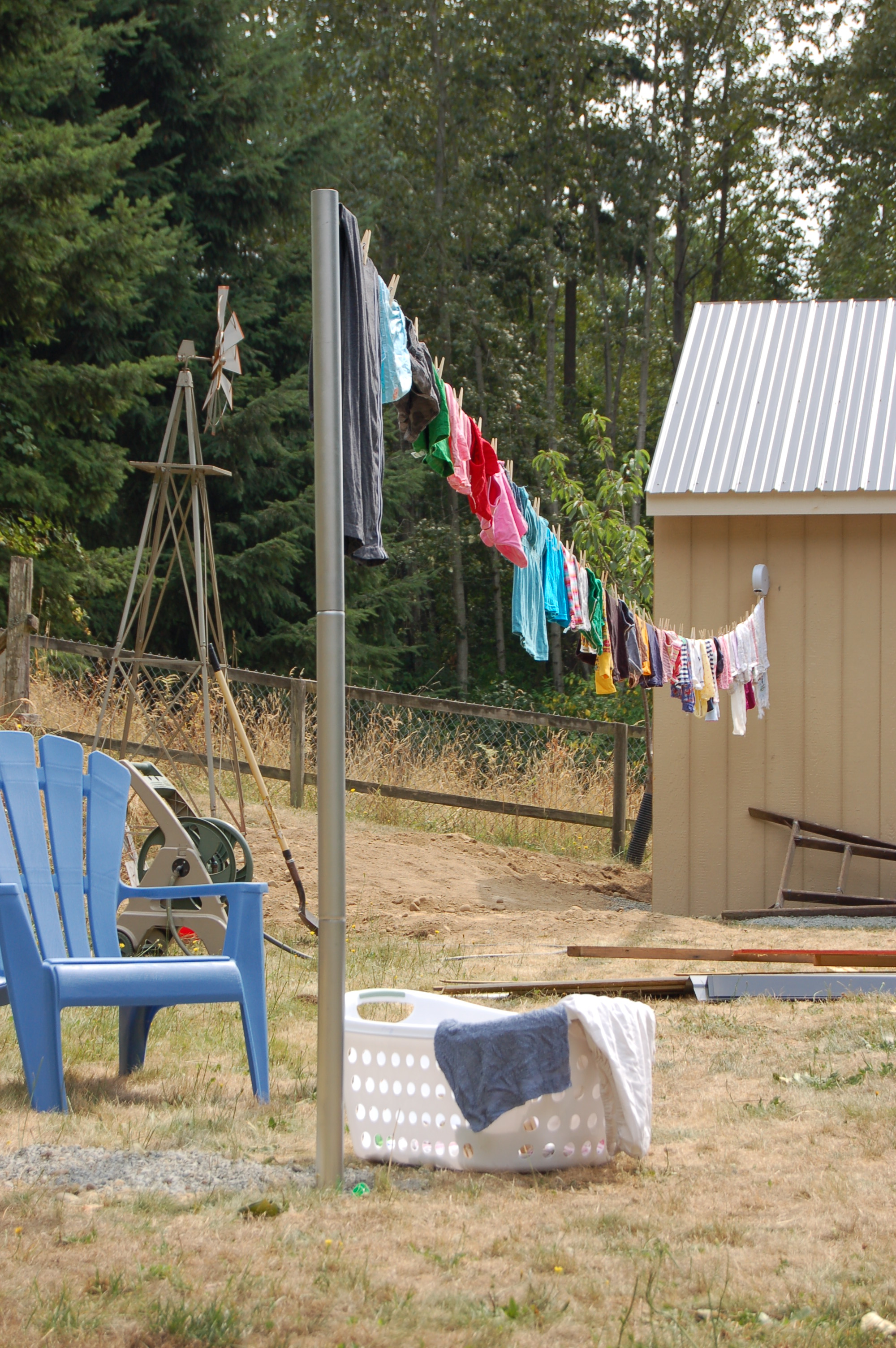
With the onset of rain, our outdoor clothesline is out of commission.  During the warmer weather, we had been doing a great job of using the clothesline.  I’d say we dried about 50% of our laundry on the line each week since putting the line up. This percentage will likely come down with the end of summer, though I did buy an indoor clothes rack from Ikea.  I can’t do as much on the rack as I did on the line, but maybe I’ll be able to do two out of six loads on the rack. We’ve also been doing many more cold wash cycles, to reduce usage of our hot water heater.  Laundry day has historically been our worst electricity usage day of the week, and our efforts have helped us smooth out our usage spikes, but we haven’t made much significant progress in bringing the overall electricity numbers down.  As you can see here, we have a slight year over year drop, but with all the changes we’ve been making in how we use electricity, I had been hoping to see more.  The only thing that makes me not feel terrible about our slow progress last month is that we spent half of the month home on vacation, which means we had a whole lot more days in the house than during a typical month, and we always use more electricity when we are home.

September electricity bill

September electricity bill

With the colder weather, we recently turned the furnace back on.  For me, 62 degrees in the house is just too cold.  We’ve programmed the thermostat to be 68 degrees when we are home, 60 degrees when we are away, and 62 when we are asleep.  We’ll play around with the numbers and schedule to see if we can reasonably bring furnace usage down a bit more.  So far, I’ve resisted turning the thermometer up to 72 and have found that the more time I spend outside gardening, the more 68 feels nice and cozy when I come back indoors.

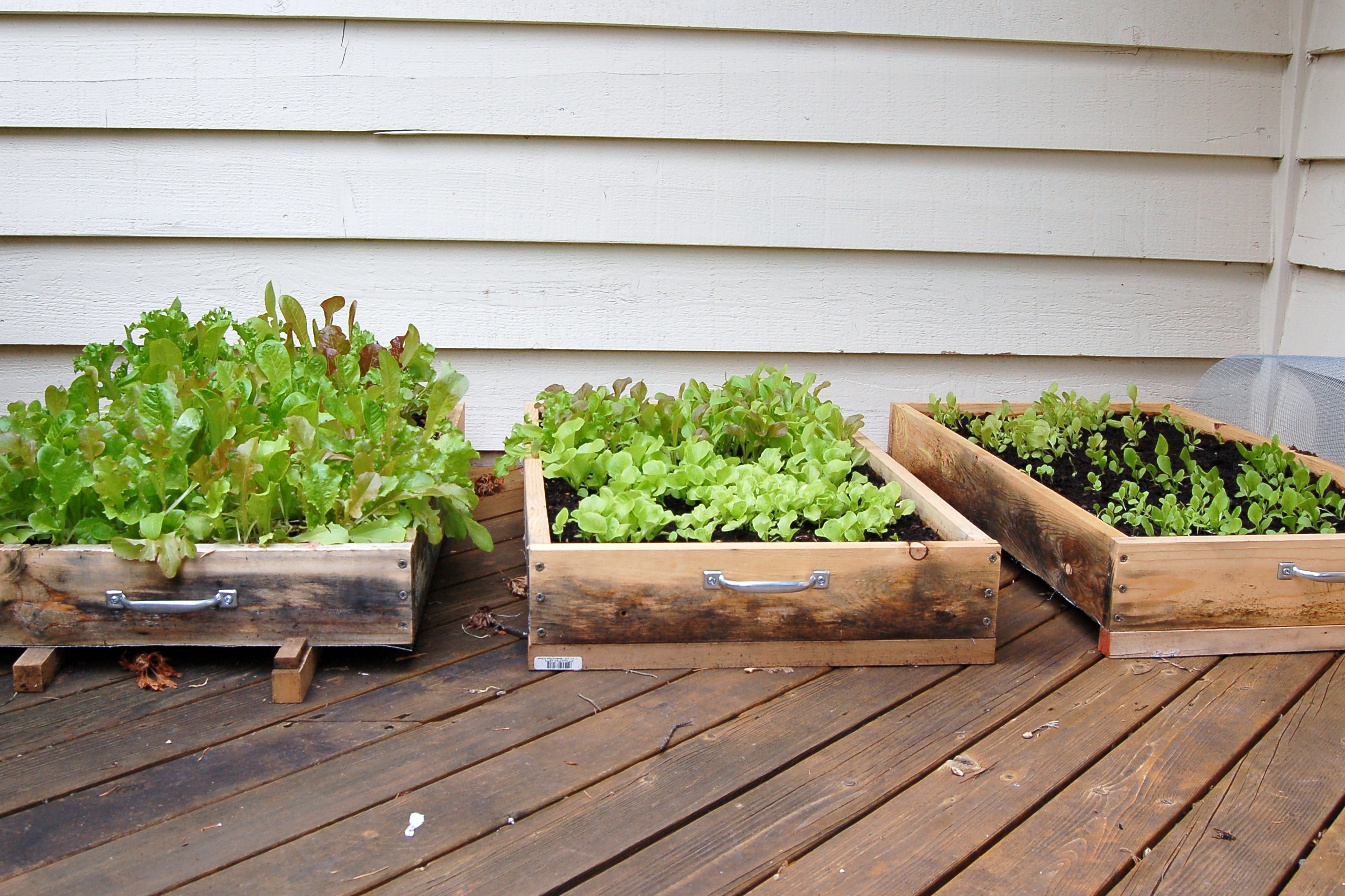
Even though the weather has changed, I’m continuing on with my fall gardening.  I replanted, in the rain today, the first of the three lettuce boxes I have in rotation.  I cut and come again harvested the first box for nearly two months and recently found that the latest batch of lettuce was starting to have a bitter taste.  I’m definitely becoming spoiled when it comes to having perfect lettuce.  I pulled out the old lettuce, threw it in the chicken coop, and then replanted with an heirloom lettuce cutting mix. The second of the three lettuce boxes is ready for harvesting, so the timing for the replant was just about right on.

Chocolate zucchini bread

Chocolate zucchini bread

And finally, colder weather allows for more indoor projects, like baking.  Like many other gardeners this time of year, I have too many zucchini.  I only have two plants, but even two plants produces more than we can deal with.  Next year, I will only plant one zucchini plant.  I did find a good chocolate zucchini bread recipe.  If you’ve got some extra zucchini on hand, give this one a try. Chocolate makes everything better . . .

Sandy

Posted in Electricity usage, Water collection | Tagged , , , , , | 6 Comments

Homegrown Revolution

We’ve been very busy this week working on the greenhouse (putting in insulation and shelves) and planting fall crops. So far, we’ve planted onions, lettuce, radishes, spinach, chard, peas, broccoli, and cabbage. I’m also trying a greenhouse-friendly cucumber variety. We’ll see if it works out. Since we’ve been so busy, I’ve had little time to write.

I did, however, dig up this great video about the Dervaes family. They have an urban homestead in Pasadena, growing an amazing amount of food on a small plot. They run the Path to Freedom site and the new gardening community site, Freedom Gardeners. I find them quite inspirational. Enjoy.

“Don’t look for others to change. You start by changing yourself.” — Jules Dervaes

Sandy

Posted in Homesteading | Tagged , | 2 Comments

School days (and carpooling woes), more chickens, and lettuce success

School bus by Johnny Blood

School bus by Johnny Blood

With the start of school, our effort to carpool is falling apart. Previously, our two kids attended the same school. This made it very easy for Derek and I to drop them off at their school and then head to the office. But the start of kindergarten is making our weekly drop off/pick up schedule much more complicated and carpooling isn’t going to work. You see, in an effort to avoid having to put our daughter into after-school care, Derek and I are now working split schedules. He’s going into the office very early so he can leave at 3:00 to do the kindergarten pickup. I am doing the bus drop off and daycare drop off in the morning, meaning I will need to stay at the office later in the day. We’ve been talking about a plan to leverage the commuter bus system run by the company we work for to lessen the impact, but the logistics and timing might be difficult.  One small saving grace is that we are having our daughter take the school bus instead of making an extra trip to drop her off at the school. At least she’s carpooling right now. To keep track of how much we are driving, I’ve created a mileage log page.  After we get settled into our new school routine, we will see how we can shave our weekly mileage down.

Salty (black and white Barred Rock) and Whitey (Delaware)

Salty (black and white Barred Rock) and Whitey (Delaware)

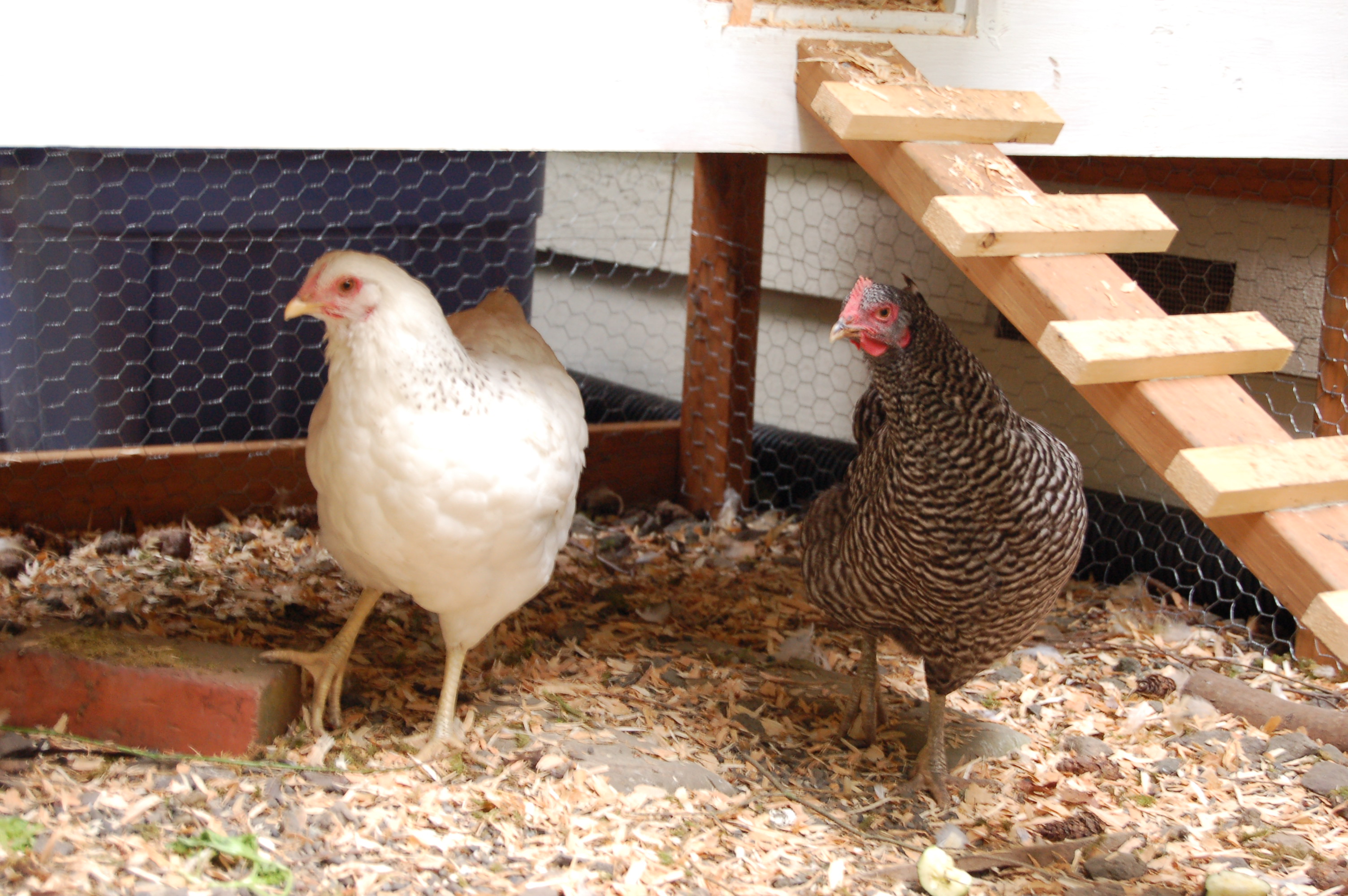
In brighter news, we’ve expanded our flock of chickens from four to six.  We added a Delaware and a Barred Rock, Whitey and Salty respectively.  Blondie, Golden, Ebony, and Blackie haven’t been too thrilled about the new additions and have been picking on the new arrivals a bit. I didn’t realize how quickly chickens would work out a social system (pecking order) and how this all has to be worked out anew when new chickens are introduced.  I did a little research and people have all sorts of ideas about how to integrate flocks.  Today, I gave Salty and Whitey some time alone in the run and then let them free range (within the fenced in side yard) with the rest of the chickens.  The pecking is getting better, but I fear poor Salty and Whitey might be doomed to be at the bottom of the pecking order. Hopefully this will all settle down over the next few days and we’ll start seeing some eggs soon.

Lettuce boxes, successive planting

Lettuce boxes, successive planting

Also in brighter news, here is a current shot of the lettuce beds we built earlier this summer.  I’ve been “cut and come again” harvesting the first bed for over a month now.  I’m pretty sure that these three boxes can keep us in a constant supply of lettuce.  When the weather turns really cold, I’ll move the boxes to the greenhouse.  Speaking of the greenhouse, we’ve been busy doing our first fall planting in the greenhouse raised beds.  So far I have planted carrots, peas, spinach, chard, onions, broccoli, and radish.  I’m also trying out some greenhouse-friendly cucumber seeds.  Arriving soon will be garlic bulbs and new raspberry canes.  The raspberries will be planted in a raised bed as well (although not in the greenhouse).  P~ at A posse ad esse recently had a great post about the benefits of fall planting.  He’s sure right that cool weather crops germinate must faster for the fall planting than the spring planting.  The little broccoli and pea seeds I planted just four days ago have already started peeping through the soil.  What a great way to start the fall season. Happy gardening.

Sandy

Posted in Gardening, Homesteading, Transportation | Tagged , , , , , | 2 Comments

Greenhouse: Under the polycarbonate

Polycarbonate siding on greenhouse

Polycarbonate siding on greenhouse

I’ve received a few emails from people curious to know more about the greenhouse.  When I started researching greenhouse options, I primarily looked at kits.  There are numerous online and catalogue retailers that sell all shapes and sizes of greenhouses.  I had an idea, however, for a structure that would be multi-purpose and I didn’t see any kits that were what I was looking for.  After doing some research, I found a plan for a passive solar greenhouseon the University of Missouri site.  The plan I saw there was very similar to a concept I had sketched out, plus the objective of the project was to make it low-energy using.  Intrigued, I called a local shed building company and was referred to Don Leikness, who ended up building the greenhouse for us.  Don did a great job and I enthusiastically recommend him (he can be reached at bleikness@aol.com).

Raised beds, hanging planters, and open sides

Raised beds, hanging planters, and open sides

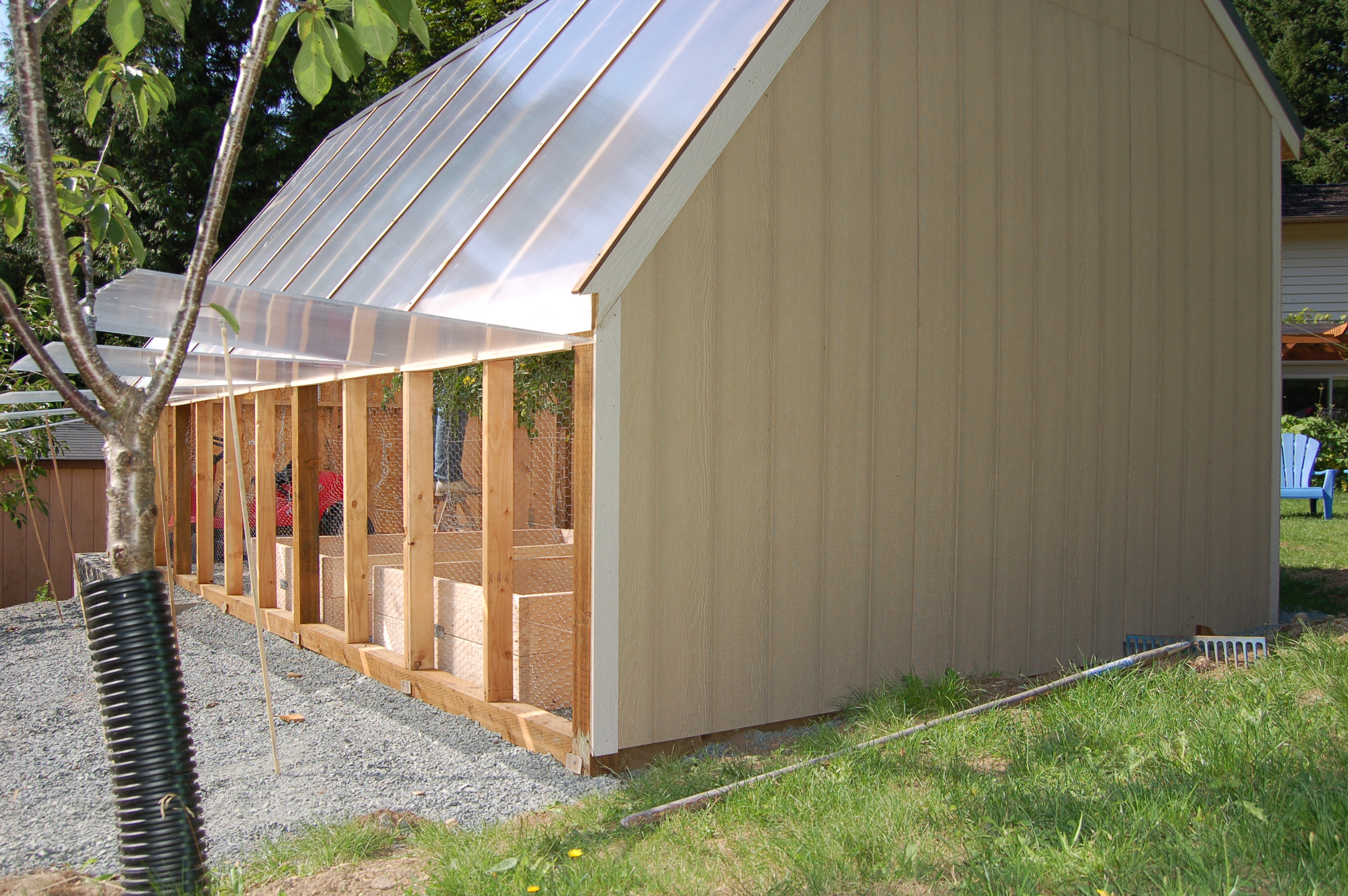
One of the things I like best about the greenhouse is that the sides open up.  This allows for great ventilation on the hottest days.  It’s hard to see, but we covered the openings with chicken wire.  We originally did this to use the greenhouse as a temporary chicken coop, but we decided that the wire is a good idea because it will keep bunnies out.  You can also see in the photo to the right that we have a number of hanging planters.  One advantage of the tall height of the structure is that it gives us plenty of space to hang plants.  Since our summer stalled out and the weather has been cool, I moved all our hanging planters into the greenhouse and they are thriving.  Also in this shot you can see the three raised beds Derek just built.  These are 4′ X 6′ X 15″ beds. I am having a load of soil delivered soon and will be planting a fall/winter crop. Along the back wall, you can also see that we are creating a space to hang garden tools.

Here I’ll hand it over to Derek to explain additional details of the project . . .

Structure and rafters

Structure and rafters

Framing is 2″x4″ Douglas fir studs set on a 4×4 pressure-treated sill.  The stud spacing is 2′ on center with ties at every 4′ (e.g. a bunch of 2’x4′ rectangles).  The sheathing is exterior-grade OSB (oriented-strand board – specifically LP Building Products 3/8″ Smart Side Panel).  The south (cripple) wall is 4′ tall, the north wall is 8′ tall and there is a 12′ ridge approximately 2/5 of the distance between the north and south walls.  The north-facing roof is corrugated (galvanized) metal over OSB.  We chose a metal roof for the reasons highlighted in our previous article on roofing.  The south-facing roof and south cripple wall are polycarbonate panels, which offer better durability and better insulation than the plastic used in the original U of M project.  The ceiling joists are 2x4s that tie from the top of the north wall to midway up the south roof framing (as seen below):

Heat sink pit and pipe

Heat sink pit and pipe

When we had the site prepped for construction, we ask for a pit to be dug so we could set up a heat sink.  A heat sink is a low-tech version of a heat pump.  In a nutshell, the way it works is a small (e.g. 92-100 mm) 12VDC fan is placed inline with a pipe (still need to build the manifold for this – it’s currently sitting on my desk) that extends from the ridge down to the bottom of a 3x3x3′ insulated pit filled with pea gravel.  The fan is designed to blow downward, sucking hot (or warm in the dead of winter) air from the top of the greenhouse and blowing it into the bottom of the pit.  The warm air heats up the pea gravel during the day providing the heat sink.  During the night, the fan continues to blow and the cooler air passes through the heated pea gravel and extracts the heat, blowing it into the greenhouse.  At least that’s how it is supposed to work.  We’ll see if theory matches practice.

We chose an approximate 60-degree angle for the polycarbonate roof to provide an optimal sunlight angle (per the U of M article, it should be latitude + 10 degrees).  We had to fudge a bit since we didn’t want a 3′ cripple wall, so the actual angle is closer to 57 degrees.  Not a big deal as the greenhouse gets plenty warm right now (in fact, it is almost too warm when I’m in there assembling raised beds or shoveling gravel or filling the raised beds).

Still on the to-do list:  adding gutters on both eaves for rainwater management and collection, adding rigid foam insulation to the interior walls, filling the three 4×6′ raised beds with topsoil + compost, adding additional storage on the east wall (tools) and north wall (shelving), adding eave venting, heat-sink venting and electrical (solar panel + inverter + battery bank).  Not a lot <cringe>. 

Sandy and Derek

Posted in Gardening | Tagged , , , | 21 Comments

Cooped up: Chickens in their new home

The new coop

The new coop

We’ve been housing our four new chickens in the greenhouse while we waited for the coop to be built.  Luckily, the weather has been mild and it hasn’t been too hot in there.  Dylan from ChickenRanching.com came over yesterday and built an elevated shed-style coop for us with an attached, enclosed run in our side yard. There is a large opening on the back side that we can use to fill their feeder and collect eggs (after they actually start laying). We chose the side yard location for a few reasons: 1.  It’s one of the few completely level parts of the yard, which makes it an easier build location, 2.  We wanted it to be pretty close to the back door so we can easily get to it for feeding, watering, and collecting eggs, and 3. This is the only area of our yard that is completely fenced in.  This means we can let them out of the run during the day to forage in a larger space, making them somewhat free range. Before we let them free range, however, we will need to cut their wings.  While in the greenhouse, the two Australorps (the black chickens) easily flew out of the top of the open greenhouse dutch door. Dylan gave us a suggestion about clipping their wings at night when they are sleepy.  I also found a good wing-clipping diagram on the Backyard Chickens site. Backyard Chickens also recommends the deep litter method for chicken bedding and bedding cleaning.  Since this method only requires cleaning out the coop once or twice a year, I’m willing to give it a try!

Coop in the side yard

Coop in the side yard

To get the chickens into the new coop, I had to move them from the greenhouse.  After a good ten minutes of trying to catch the chickens (to put them in a dog carrier for transport over to the greenhouse), I decided there had to be a better way. Chickens are surprisingly fast, and running after them and lurching to catch one was making me feel pretty dumb.  It’s pretty sad when you are feeling outsmarted by a chicken.  Lily, my helper in this endeavor, and I decided we would come up with a plan.  We devised a chicken “run” by strategically placing the large lemon and lime tree pots in the corner of the greenhouse.  We then set up the dog carrier so that we could chase the chickens behind the the pots, through the run, and into the dog carrier.  This solved the problem pretty quickly and we soon had the chickens in their new coop.

Now that they are in their coop, we are hoping they will figure out how to walk up the ladder to get into the coop.  We sprinkled chicken feed on the steps of the chicken ladder and put their food inside.  One chicken pecked it off the steps and didn’t step foot on the ladder.  Derek even went out, caught a chicken, and plopped it through the coop door. It popped out as quickly as it went in. I suppose if we keep their food in the coop, they’ll eventually figure out how to get in there, at least I hope so.

Update:  Nancy, in comments, suggested we try moving the chickens from the run into the coop at dusk.  She was right! At dusk, the chickens were very docile and easy to grab.  Derek went into the coop and quickly grabbed each one and plopped her in the coop.  They figured out the roost and slept there all night. We opened the coop door this morning and it took a bit, but they figured out how to walk down the coop ramp and are now pecking away in their run.

Another update:  The chickens go into their coop at dusk without my assistance.  All I have to do is close their coop door and they are safely set for the night. Super easy!

Sandy

Posted in Homesteading | Tagged , , | 3 Comments

Photo album: Chickens, goats, greenhouse

Ebony, Blackie, Blondie, and Golden

The girls: Ebony, Blackie, Blondie, and Golden

We bought four chickens on Saturday.  Two Australorps and two Buff Orpingtons.  I figured out which breeds to get by using a breed selector tool.  Who knew such a thing existed?  In selecting chickens I was looking for a few things:  1.  Mild temperaments, 2.  Good year-round laying. We purposefully chose pullets, which are essentially teenage hens, because we didn’t want to have to deal with very young chicks that require heat lamps and because we wanted the chickens to begin laying eggs soon.  Pullets are definitely more expensive than chicks, but for novices like us we figured it would be an easier entry into chicken keeping.  I bought the chickens from a nice iPhone-using chicken rancher in Everett who retired from Microsoft.  I found him via Craigslist.  Both BackyardChickens.com and MyPetChicken.com have been useful resources as we figure out how to care for the chickens. 

Shots of Harry and Lucy, our goats.  They’ve been happily grazing all summer. In fact, they are looking a bit obese.

Harry the Pygora goat

Harry the Pygora goat

Lucy the Alpine/Nubian goat

Lucy the Alpine/Nubian goat

The new passive solar greenhouse, with the sides open, and a shot from inside the greenhouse of our menagerie.

Chickens, goats, dog, and Lily

Chickens, goats, dog, and Lily

Passive solar greenhouse

Passive solar greenhouse

The chickens will be moving into their permanent home, the new coop, on Monday. We’ll post pictures of the coop later this week.

Sandy

Posted in Homesteading | Tagged , , , , , , , | 7 Comments

Electricity usage: One step forward, two steps back

August electricity usage

August electricity usage

Between the middle of July and the middle of August, we installed a few dozen new compact fluorescent bulbs in our house. We’ve been more diligent than ever about turning off lights.  As the middle of the month approached, I was getting excited about seeing our energy bill because I thought we’d see a nice noticeable dip in our electricity usage.  Then the bill arrived.  And here you see it. For our July bill, we used 880 KWH (kilowatt hours), for August it was up to 1040 KWH. That’s an 18% increase. Why, oh, why???

Thinking about the differences between the two months, I can only think of two things. First, we spent a few days during the July billing cycle out of town, so usage was very low on those days. Second, for a week during the August billing cycle, our greenhouse was being built. This required the use of equipment that drew electricity, primarily an air compressor and various saws. Aside from these two differences, our usage patterns were pretty much the same or better in August — except we installed all those compact fluorescent bulbs, which should have helped. Since we’ve also started using the clothesline, I am hoping we see better results in our next bill.  We might also buy a Kill A Watt product to be able to measure the usage of our various appliances.  And I have to say a real-time home electricity monitoring system is starting to look tempting as well.

On a positive note, our greenhouse was finished on Monday.  I’m going to take and post pictures this weekend.  Also, we’re going to build the chicken coop on Monday.  So, even though our electricity reduction program isn’t going as well as planned, we’re making real progress on the suburban homesteading front.

Sandy

Posted in Electricity usage | Tagged , , , | 2 Comments

Hung out to dry

Clothesline in action

Clothesline in action

While we may be looking a bit countrified, a bit Ma and Pa Kettle in this photo, it actually shows that we’ve made some real progress. If you look past the dormant lawn/weeds that have turned into exposed dirt thanks to the regrading needed for the greenhouse, if you look past the broken, “decorative” windmill, and if you look past the pile of construction debris, you’ll see that we now have a real, working clothesline and that it is actually in use. In fact, I used it to dry three of our five loads of laundry this weekend. Hopefully, this will bring down our weekend energy spikes. With such warm weather, the clothes dried very quickly.  And I’ve found that I can get rid of that crunchy clothesline feeling if I throw them in the dryer for five minutes for fluffing. The nice, dried-outside smell remained.

Weather in our area can be quite changeable.  In fact, after our hot weather today, we had a light rain this evening.  This got me thinking about how we could get the benefit of a clothesline even after the weather turns wet again.  UrbanClotheslines.com has some interesting indoor hanging racks that I’ve looked at, but we don’t have a lot of space in our laundry room.  And I don’t really like the idea of setting up a drying rack in our everyday living space, so a big inside-the-house drying rack system isn’t my first choice.  Thinking about different options, it occurred to me that the greenhouse could also be a good place to put a drying rack.  The greenhouse is covered, so no rain, and it is hot (and will be warm even during winter months).  There will be good air circulation from the fan system. And it’s big — certainly big enough for a drying rack, maybe something like this from Ikea (note: Ikea has a number of different drying rack options and they are all less expensive than what you would find on UrbanClotheslines). Once the weather turns wet, I’ll give this a try.  Again, even if I dry just a few loads a week this way, it will help bring our electricity usage down.

Speaking of our electricity usage, I received our latest utility bill.  We actually used a bit more electricity in the last month than we did the previous month — this, after installing about a gazillion new compact fluorescent bulbs.  I was really surprised our usage went up and will be using the tools on the Puget Sound Energy site this week to figure out what happened.  I do have a theory related to the greenhouse build and all the power tools that were drawing electricity . . . .

More on the greenhouse soon. It’s really truly 95% done and should, crossing our fingers, be complete early this week.

Sandy

Posted in Electricity usage | Tagged , , , | 5 Comments

Extreme green living and sustainable sustainability

Bungee by .Martin.

Bungee by .Martin.

On the occasions I’ve watched The Biggest Loser, I couldn’t help but think it was a terrible example for showing people how to lose weight. Sure the candidates had amazing, dramatic results, but the methods were extreme and not exactly something the everyday Joe or Jane could do. In fact, instead of inspiring people, I bet the show has made a number of people think losing weight would be so hard — and frankly so painful — that they couldn’t possibly be successful.  As I become more involved in the world of green living, I am coming across a number of examples of extreme green living that remind me of The Biggest Loser — both inspiring and deflating at the same time.

First up, No Impact Man. No Impact Man became a media figure when he embarked on this year-long journey, explained in his own words: “For one year, my wife, my 2-year-old daughter, my dog and I, while living in the middle of New York City, are attempting to live without making any net impact on the environment. In other words, no trash, no carbon emissions, no toxins in the water, no elevators, no subway, no products in packaging, no plastics, no air conditioning, no TV, no toilets….” This was a hugely noble undertaking and he certainly raised awareness and helped many people, myself included, become inspired to reduce environmental impact. But at this extreme level, it wasn’t sustainable.  Even No Impact Man had to do it for only a finite period of time.  While his current impact certainly remains far below what it was prior to his experiment, he’s backed off a bit, following a plan that for him and his family is sustainable for the long-term.

Next up, hypermilers. The key objective of hypermilers is to increase their miles per gallon by changing how they drive their car. There are six main steps to hypermiling:

  1. Closely tracking your mileage by recording miles driven and gallons purchased each time you fill your tank.  This is something I’ve committed to doing starting in September.
  2. Avoiding driving aggressively because fast starts and stops have a negative impact on MPG.
  3. Avoiding long stops at red lights.
  4. Keeping your car moving in traffic congestion.
  5. Slowly accelerate after stops.
  6. Using your cruise control.

Many of these steps sound simply like safe prudent driving advice.  Others (avoiding long stops and traffic congestion) can be merely impractical. So why do I say hypermiling can be problematic?  Because there is a segment of hypermilers that take these practices to extremes, extremes that become dangerous. So I’m willing to follow the basic idea of moderate driving (I’ve been experimenting with keeping my RPMs under 2000), but I won’t practice any of the dangerous techniques like drafting behind semi-trucks or turning off the engine and coasting downhill. And neither should you!

And finally for this post, off-the-grid-ers. Off-the-grid-ers strive for complete independence for their home energy needs.  Again, on the face of it this sounds like a great idea.  Who wouldn’t want to be completely independent energy-wise?  The challenges here are a fewfold: 1.  Doing this is typically pretty expensive, cost prohibitive for the vast majority of people, 2. For most of us living in an urban or suburban setting, it probably isn’t fully possible to achieve off-the-grid independence, and 3. Off-the-grid-ers don’t feed back into an energy grid, which means some of their surplus energy could go to waste. As Derek and I think about our goals for a future solar installation, we are hoping to become largely independent, but will do a grid-tied system so that we can feed any surplus energy back into the collective energy grid. For others, the solution will require that local utility companies become greener, and that green energy programs become the standard for everyone.

As Derek and I shed the weight of heavy carbon usage, we want to do so incrementally, one step at a time, becoming our long-term way of living. We are striving for sustainable sustainability. We plan to avoid becoming one of those inevitable biggest losers who make a valient, heroic effort to get to their goal only to end up gaining back all the weight.

Sandy

Posted in Energy usage | Tagged , , , , , | 2 Comments